Halo Masking
A halo mask excludes grid cells within a physical buffer (measured in real km) of an unwanted region (land or
sea ice). Mostly used for sampled cutout centers to stay far enough away that the cutout doesn’t overlap it.
The buffer distance is usually the cutout size (target_km_res).
Why
In context of cutout sampling, each cutout spans target_km_res km. A center near land/ice yields a cutout that overlaps
land/ice. Buffering the excluded region by ~one cutout width keeps sampled cutouts in open water.
Algorithm
halo_mask.stitched_halo_mask(mask, dxC, dyC, halo_km):
input
mask:True= cells to exclude (land or ice).builds a signed level set and runs fast marching (
skfmm.distance) to get each cell’s distance (km, fromdxC/dyC) to the nearest excluded cell.returns
Truewhere distance ≥halo_km(retained).llc_native_grid_halo_maskis the per-face variant for the native grid.
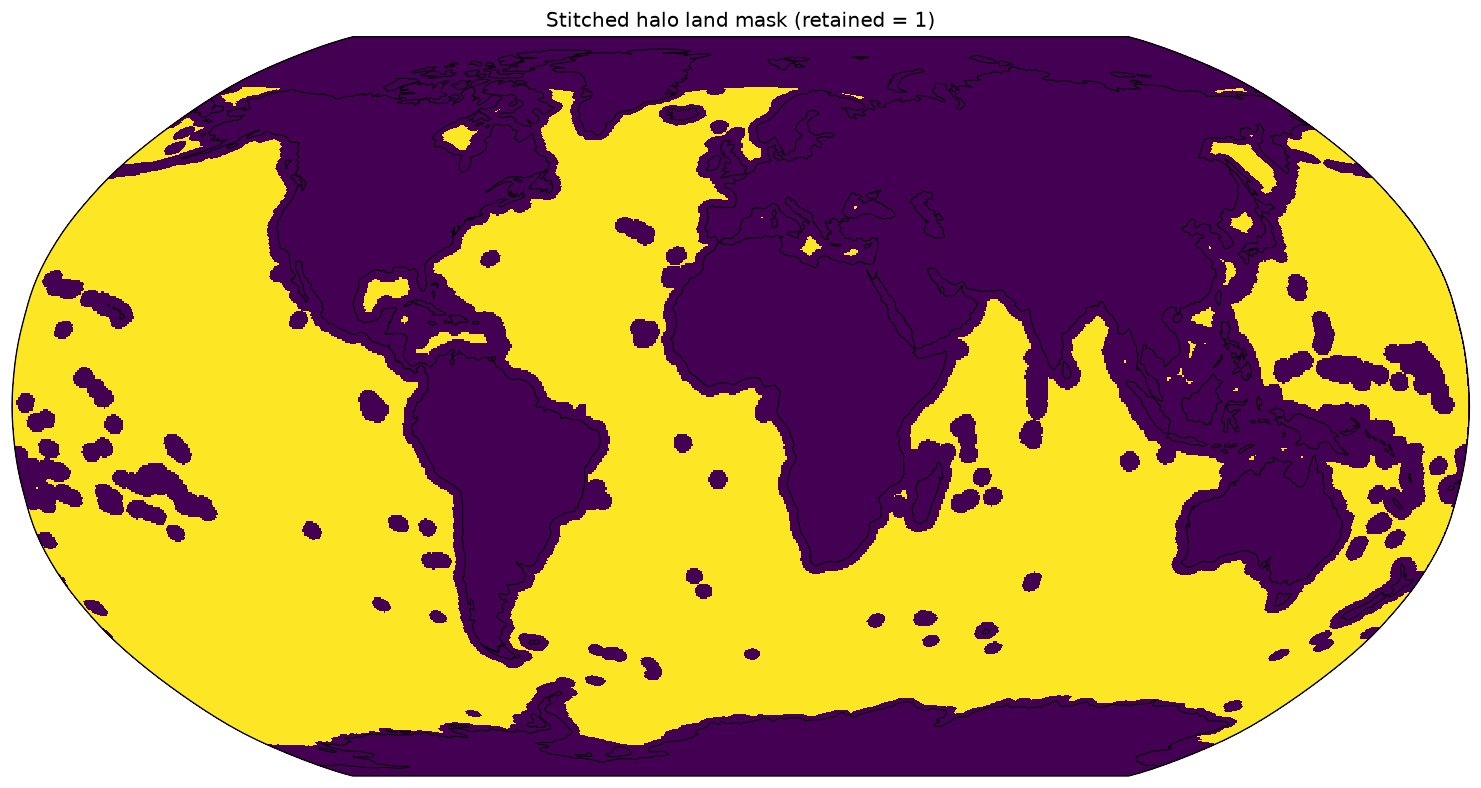
Land mask
static_masks.generate_halo_land_mask(ds_grid, target_km_res, stitched=True) — land is
hFacC == 0, buffered by target_km_res. Static: computed once per run.
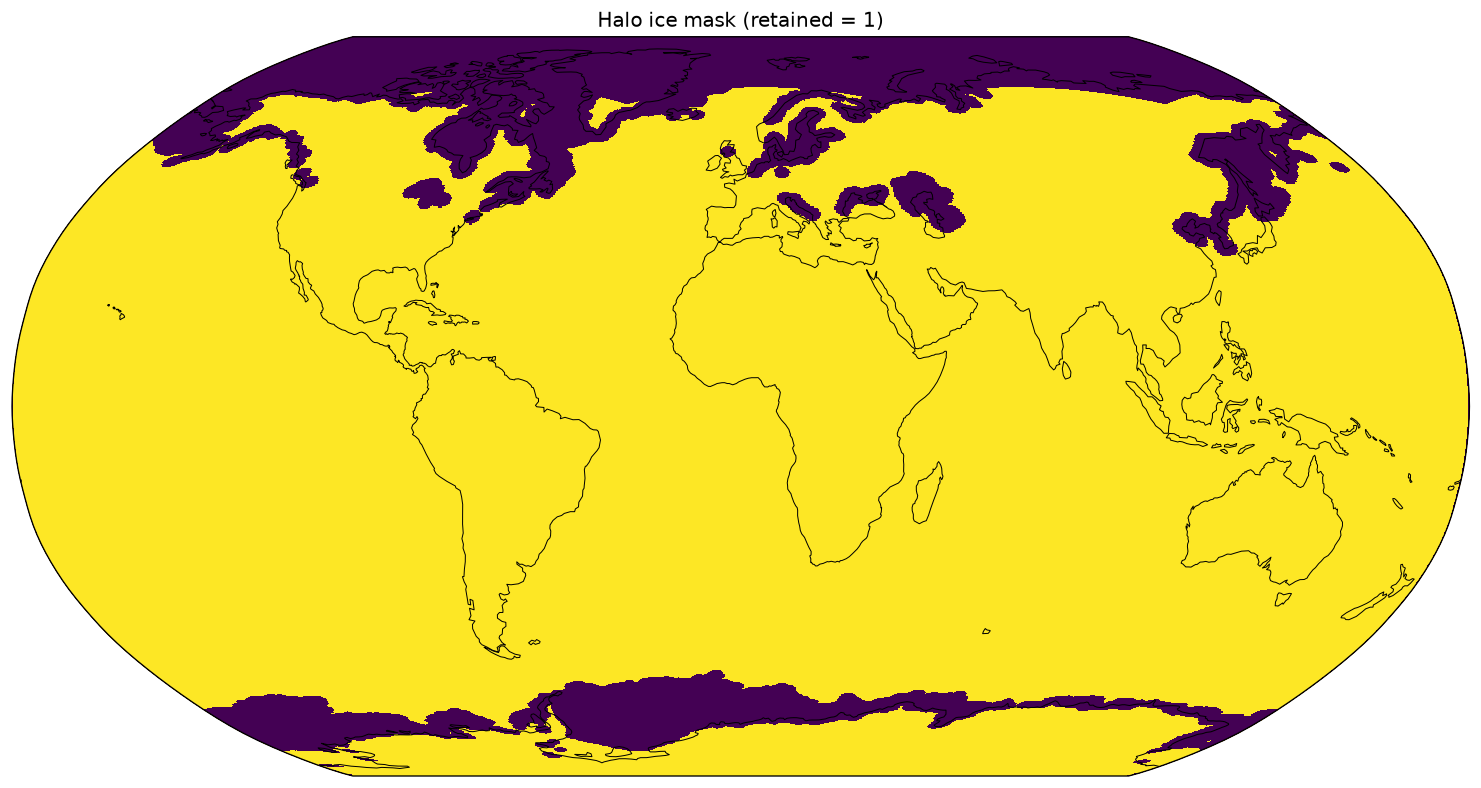
Ice mask
ice_mask.generate_halo_ice_mask(ds_grid, ice_mask, target_km_res, stitched=True) — ice is
SIarea > 0 (generate_siarea_mask), buffered by target_km_res. Per-snapshot: ice moves.
Sampling mask
Cutouts are sampled where both hold:
build_sampling_mask = halo_ice_mask & land_halo_mask (True = eligible ocean).
Import
import dbof.preprocessing.static_masks as static_masks
import dbof.preprocessing.ice_mask as ice_mask
Notes
Convention: input mask
True= excluded; outputTrue= retained.halo_kmdefaults totarget_km_res.Fast marching runs over the full stitched grid — the heaviest per-run / per-snapshot step.
This can rarely fail in the cutout generation leaving land or ice in cutouts at very specific location on the grid. This is a chosen sacrifice as a larger km buffer would exclude more of our data source.